


Super User
Flash 2
Lorem ipsum dolor sit amet, consectetur adipiscing elit. Sed tincidunt, lorem id bibendum ultricies, massa erat sodales mauris, vitae congue erat massa luctus nisl. Vestibulum auctor mattis luctus. Quisque gravida ut elit eu rutrum. Nulla eu leo ligula. Nunc mi lectus, pretium at magna eget, sodales aliquet diam.
Flash 1
Lorem ipsum dolor sit amet, consectetur adipiscing elit. Sed tincidunt, lorem id bibendum ultricies, massa erat sodales mauris, vitae congue erat massa luctus nisl. Vestibulum auctor mattis luctus. Quisque gravida ut elit eu rutrum. Nulla eu leo ligula. Nunc mi lectus, pretium at magna eget, sodales aliquet diam.
How biographic is "Pax English"?
"We are the stories we share", Rodrigo wrote. "Pax English" drives readers throughout a long historical and geographical trip around the globe. Trips, people and dialogues are real.

"Pax English" was written solo - however Rodrigo was not alone. He quotes many friends and their talks around the theme of the book.
What's Next?
As "Pax English" is launched, Rodrigo aims now at running the Montblanc Ultra Trail (the Athens Marathon and long-range ultratrail races have not been enough). He is also planning to run the Paris-Dakar Rally with his elder son (although he might do better with words than with wheels). Rodrigo has three sons, two dogs and countless Darth Vader gadgets - all of them keep reminding him that home is where his writing rollerball pen and Moleskine notebooks are.
Is Rodrigo an Anglophone?
 "A small disclaimer that seems important to me. This book deals with the possible consequences of using English on a large scale. But that doesn't mean I'm making an apology for English nor making any favourable judgments about the English-speaking world. Allow me a brief explanation. I was a child in the cold war, but I grew up in a world with almost no walls. I was a child when my country, Portugal, handed over its last colony, but I grew up in a world with almost no colonies. I was raised in a home where it was chic to speak French, but where German was chosen for my second language. My parents looked to French as the elite language and German as the language of the future of the economy. Today I go to China more often than to the United States. I've been more in Africa than in the UK and I just saw Brexit. I don't have an emotional tie that binds me to the English-speaking world. But I recognize the ideological charge of languages. I do not only recognize it, but I also consider their political influence as a useful variable in this analysis. That's right. A variable, not the rule. The truth is my parents failed their prediction: Germany, as a country, had more economic future than its language: Germans learned to speak English – which made my (bad) German absolutely unnecessary. Even when I go to Germany I speak English. And this corresponds to the concept of a lingua franca. And, in that aspect, the English got that status. It wasn't really English, but something similar. Let's say that globalization needed a form of common understanding, and English was handy". [Rodrigo Moita de Deus, "Pax English"].
Behind the Scenes
 Rodrigo has been playing with words since late 90’s: from journalism to public affairs, from television to books, from a well-known blog to a museum.
Before "Pax English", Rodrigo has published two books. As a 23 years-old single man, he dared to publish “Será que as mulheres ainda acreditam em príncipes encantados?” (“Do Women Still Believe in Charming Princes?") a major success in Portugal which became part of the portuguese government National Reading Plan. Albeit a success, he left the relationship’s opinion-style writing to release the fictional book “O Vigarista: o homem do ano” ( “The swindler: the Man of the Year”), at the age of 25.
In an interview on this second book to TVI TV, Rodrigo said "I really admire people who are disciplined in writing. I was always unable to do it".
It took him almost 20 years to decide to publish again. Rodrigo wrote "Pax English" between 2017 and 2020 while travelling around the globe. Ironically, Rodrigo finished "Pax English" during the pandemics: "Lisbon, Portugal (April 2020). I write these lines during [the coronavirus] state of emergency. In fact, much of this book was edited while I was locked in my house without know very well what will change in the world after this. It came to my mind that I would have to rewrite part of the book in light of what is happening. I think and rethink. Maybe it's not necessary".
Is this trade book or a science book?"Not being linguists, we will hardly give this importance to languages. As a communication professional, commentator, journalist and former advertiser, I did not give language that importance either. We are narratively trained to think the world through well-delimited sciences: sociologists think sociology explains the world, economists think economics explains the world, biologists think biology explains the world - and so on. We are narratively conditioned to only give importance to our own field of study. As if the world is explainable by just one or two science fields. And so we continue condemned to the old saying that "we know more and more about less and less, condemned to know everything about nothing". We lack the essential: sciences do not explain the world. They watch you. Hence these lines have been written with no specific science. It took a few years to put this book on paper. And a lifetime to write." [Rodrigo Moita de Deus, "Pax English"]. |
 |
Pre-order now
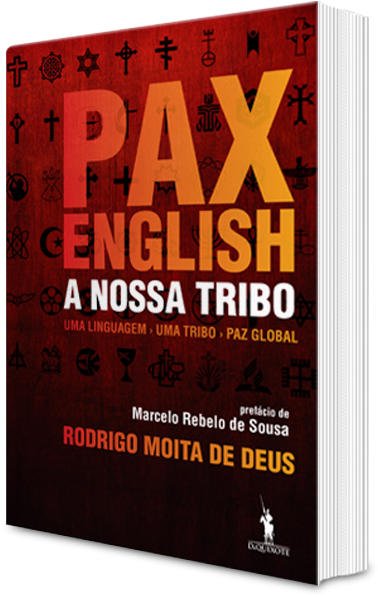 |
Pax English - Your TribePAX English will arrive to bookstores in February. |


The Doc
A cultural documentary built as a real journey, with Korgas
and the Belt and Road Initiative as the cornerstone.
Pax English - The Doc is a cultural documentary production from Xi'an, China, to Madrid, Spain. The documentary, under production, has a simple thesis: languages divide and divide men into different tribes. But the fewer languages men speak, the fewer divisions; and thus more peace around the world. This is not new: it's the principle of the old tale of the Tower of Babel that has always been present in human history. It is also a reflection of how we can overcome (physical, emotional, linguistic, cultural, and physical) borders; how we can bring people and countries together through infrastructure; and finally, the impact on our cultures. Are we creating a common culture or not? And what role does the Belt and Road Initiative play in this?